Author: Nina Luminati, Design Director
Published: 16th Jul 2026
A Textile Journey Through Kerala

Three Days in the Craft Coast of Kannur
There are few places in the world where craft still feels woven into everyday life. Kerala, on India’s southwestern coast, is one of them. Wedged between the Arabian Sea and the Western Ghats, this wet tropical region is marked by lush, green landscapes, inland backwaters and a rich history of global trade, particularly in spices and textiles.
I recently spent three days in Kannur, visiting the mills and craftspeople we work with to produce our passementerie collection. I discovered a region where centuries-old techniques coexist with modern technology, and where warmth and hospitality are given the same care and attention as the fabrics themselves.

A Patchwork of Regional Craft
India’s textile traditions are as varied as its geography. Materials, motifs and techniques shift dramatically from region to region, shaped by climate, resources and cultural exchange. In the north, embroidery traditions flourished through Islamic influence - from the delicate kantha stitch of the Bengal region to the richly textured crewel work of Kashmir, where colder climates favour thicker wool yarns. Southern India tells a different story. Cotton grows abundantly here, shaping the fabrics produced across the region. Around Kannur, this textile culture forms an entire ecosystem. Within a 50-mile radius of the central R&D facility lie more than ten weaving mills, all supported by a centralised dyeing house and a network of artisans practising over 130 specialist techniques.
Where Calico Began...
Kannur sits on a coastline that has been a trading hub for hundreds of years. Long before global supply chains existed, merchants came here searching for two things: spices and cloth. When Portuguese traders reached the coast in the late fifteenth century, they encountered a thriving trade in cotton fabrics centred around Kozhikode, then known as Calicut. The place lent its name to a fabric that would become famous across Europe: calico. Early textiles were dyed using materials sourced from the landscape itself. Even the shells of cashew nuts were used to colour cotton cloth. Watching looms in operation today, it is striking how much of that heritage still endures.

The Rhythm of the Loom
Kannur remains synonymous with handwoven textiles. Inside the weaving sheds, the sound of wooden treadle looms form a steady rhythm: frames clatter, shuttles dart back and forth, and thousands of threads remain perfectly tensioned. A single loom can contain three to five thousand warp threads, producing fabrics roughly 45” wide. The work is meticulous and slow, but it yields cloth with a depth and character that machines rarely replicate. Many of the weavers learned the craft from parents or grandparents. Skills are passed down through observation rather than formal instruction - a quiet continuity of knowledge that stretches across generations.

The Dye House - Where Science Meets Craft
Textile dyeing is often described as the one of the world’s most environmentally challenging industrial processes, so seeing the systems in place here was encouraging. A reverse osmosis filtration system allows approximately 60% of the water used in the dyeing process to be recycled, significantly reducing waste. The dyeing method used here is alkaline dyeing, a slower but far more durable process. Instead of sitting on the surface of the fibre, the colour is forced deep into the core of the yarn, creating fabrics that retain their colour for much longer and resist fading over time. The fibres themselves are sourced locally wherever possible. Cottons and banana fibres comes from southern India, while linen and hemp fibres are brought in from Kolkata, ensuring the raw materials remain closely connected to the regions that produce them.
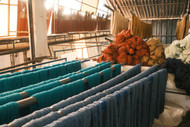
Our “Ombre Fringe” is tied at regular intervals to resist the penetration of colour, then dip-dyed by hand using sticks to guide the yarn in and out of the dye vat. Once dry, the yarn is wound onto a bobbin and handwoven into a wide tape, with one side later cut loose to reveal the dip-dyed edge.

Dip-dyed yarn

Dye vat

Dyed yarn woven by hand into a wide tape

The Cooperative Craft Villages
One of the most memorable visits during the trip was to a nearby craft village. This model has roots in Kerala’s unique political history. In 1957, the state elected the world’s first democratically elected communist government. Many industries - including weaving - were organised into cooperatives to support local communities.
Unlike the mills, this space contains no machinery. Every process is carried out entirely by hand by a group of women - from our hand-plaited “Helter Skelter” braid to the tassels for our “Jamboree Tape” and the pom-poms for our “Festoon Tape.”Each piece is made manually, often using techniques that have changed little over time. The atmosphere is slower and more communal than the factories - less about volume, and more about preserving small-scale craft skills that might otherwise disappear.


The Evolution of Craft
Despite the deep tradition of handcraft, innovation has also been essential to keeping the industry alive. In the mid-1990s, textile specialists began introducing computer-aided embroidery systems in Bangalore, which has since become India’s technology capital.
Today these systems can produce over 10,000 metres of embroidered fabric per month, allowing traditional designs to be scaled for global production while maintaining the distinctive hand-inspired look. There’s also increasing use of AI-driven inspection systems to identify weaving faults - technology that helps maintain quality while reducing manual labour.

A Network of Skills
Despite the scale of production, the industry here remains deeply connected to the people and communities who sustain it. The company we work with also plays an important role locally through its corporate social responsibility programmes. These initiatives support local schools and hospitals, helping to improve access to education and healthcare within the surrounding communities. For many families, employment in the mills provides a stable income that supports not just individuals but extended households. In a region where traditional crafts still underpin much of the local economy, these investments help ensure that the benefits of the textile industry extend beyond the factory walls.

THROUGH NINA'S LENS
Discover more photographs from Nina’s three days exploring the people, processes and landscapes of Kannur.
View Gallery
Cloth's Passementrie Collection
Our passementerie collection features a vibrant spectrum of cords, fringes, and braids that add a decorative flourish to curtains, cushions, and upholstery. Whether used as a border, an edge detail, or a final embellishment, each trim brings texture, colour, and artisanal character to any interior scheme.


